

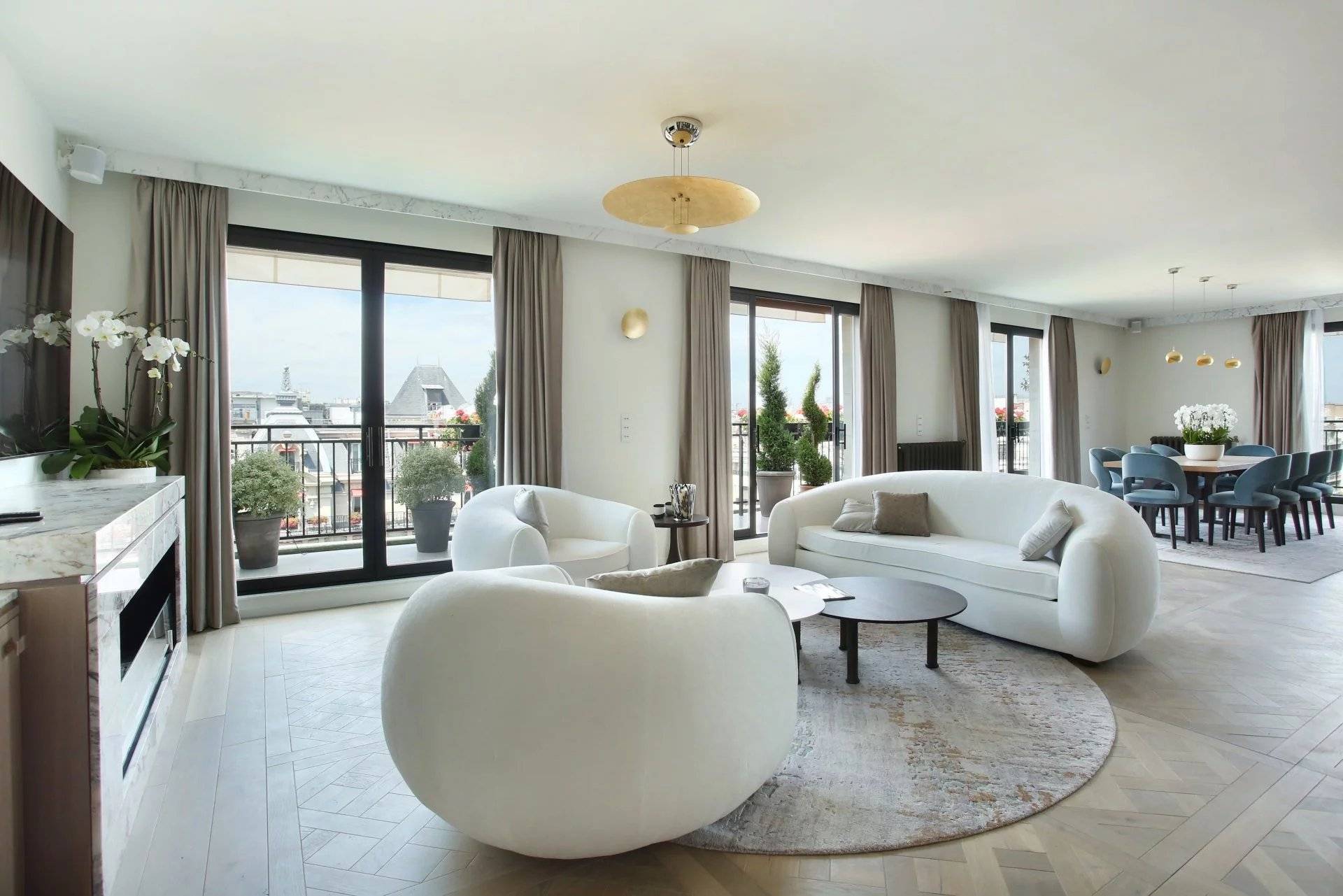
I have spent the past two years studying interior design in the evenings, and this month the British Academy of Interior Design awarded me the diploma with Distinction. I want to write about what that does and does not mean for a client, because the home staging industry makes claims I am not willing to repeat.
Start with what is actually measurable. LonRes tracks achieved prices across prime London, and in its July figures the average discount to asking price was 10.4%. Split that by how long a property had been on the market and it becomes far more interesting: stock that sold within three months went for 3.9% below asking; stock that had been sitting for more than twelve months went for 19.3% below. That is a gap of more than fifteen percentage points between a property that moves and a property that lingers.
On a £4m house, that difference is roughly £600,000.
Now the honest caveat. That is a measure of duration, not of presentation. A property can sit for a year because it was overpriced, because it is on a poor street, or because the market moved underneath it. Nobody has published a study isolating presentation as the cause. What the number does establish is that in prime London the cost of a slow launch is very large, and that whatever shortens the launch is worth paying attention to.
What the research says about staging
Less than the industry would like. The most rigorous work I can find is a field experiment by Lane, Seiler and Seiler, and its conclusion is that staging did not raise what buyers were willing to pay. What it did do, significantly, was change how buyers read the property’s condition and overall appeal, and how they moved through the purchase process. The National Association of Realtors in the United States surveys its members annually and finds that about half of sellers’ agents observe a reduction in time on market; that survey has a 2.5% response rate and records opinions rather than measured outcomes, and it is American. There is no equivalent British study. Every UK “home staging statistic” I have checked traces back either to that American survey or to a company selling furniture.
I would rather tell you that than quote a number I cannot stand behind.
What I think is true
Presentation does not create value that is not there. It removes the friction between a good property and the buyer who should want it. A room that reads as cramped because the furniture is wrong, a kitchen lit at 4,000 kelvin when it should be 2,700, a drawing room where the eye has nowhere to rest: none of these reduce the property’s worth, but all of them slow the decision, and in this market a slow decision is an expensive one.
What we now do at the valuation stage is tell you plainly which of those frictions your property has, what it would cost to fix, and which ones are not worth fixing. Sometimes the answer is that the house should be photographed as it stands. Sometimes it is that one room is doing real damage and everything else is fine. Occasionally it is that a full dressing is justified, and we will say what it should cost.
The training matters mainly because it makes those judgements specific. Lighting design is a worked discipline, not an opinion: layered circuits, everything dimmable, 2,700 kelvin at a colour rendering index of 90 or better for living space, 4,000 kelvin reserved for kitchen task light. The same is true of how a room is furnished for scale and how a palette is held together across a floor. Having studied it properly, I can tell you why a room photographs badly rather than simply that it does.
None of this is a separate service and none of it is charged for. It is part of the appraisal, along with the comparable evidence and the view on timing. The same applies to landlords: a well-presented flat lets faster, to a better tenant.
One last point for anyone weighing whether to bother. In a market where more than half of prime London sales now involve at least one price reduction, and where the average property takes 186 days to sell, the most valuable thing you can do is arrive on the market correctly the first time. Presentation is a smaller lever than price. It is a much cheaper one.
Request a valuation and we will return it in writing within 24 to 48 hours, with our view on presentation included.
Hanane Dawson, Founder
Sources: LonRes Prime London Market Dashboard, August 2026, and Prime London Market Update Summer 2026. Lane, M.A., Seiler, M.J. and Seiler, V.L. (2015), “The Impact of Staging Conditions on Residential Real Estate Demand”. National Association of Realtors, 2025 Profile of Home Staging.